Replacing Spreadsheets with ERP: A Manufacturer’s Guide
Spreadsheets aren’t the enemy — they’re what growing manufacturers reach for when they need a tool fast and don’t yet have the volume to justify a full system. The problem isn’t that you’re using spreadsheets. It’s the point where spreadsheets stop being a convenience and start being a risk. Here’s how to know you’ve hit that point, and what actually changes when you move to ERP.
Why Manufacturers End Up Spreadsheet-Dependent
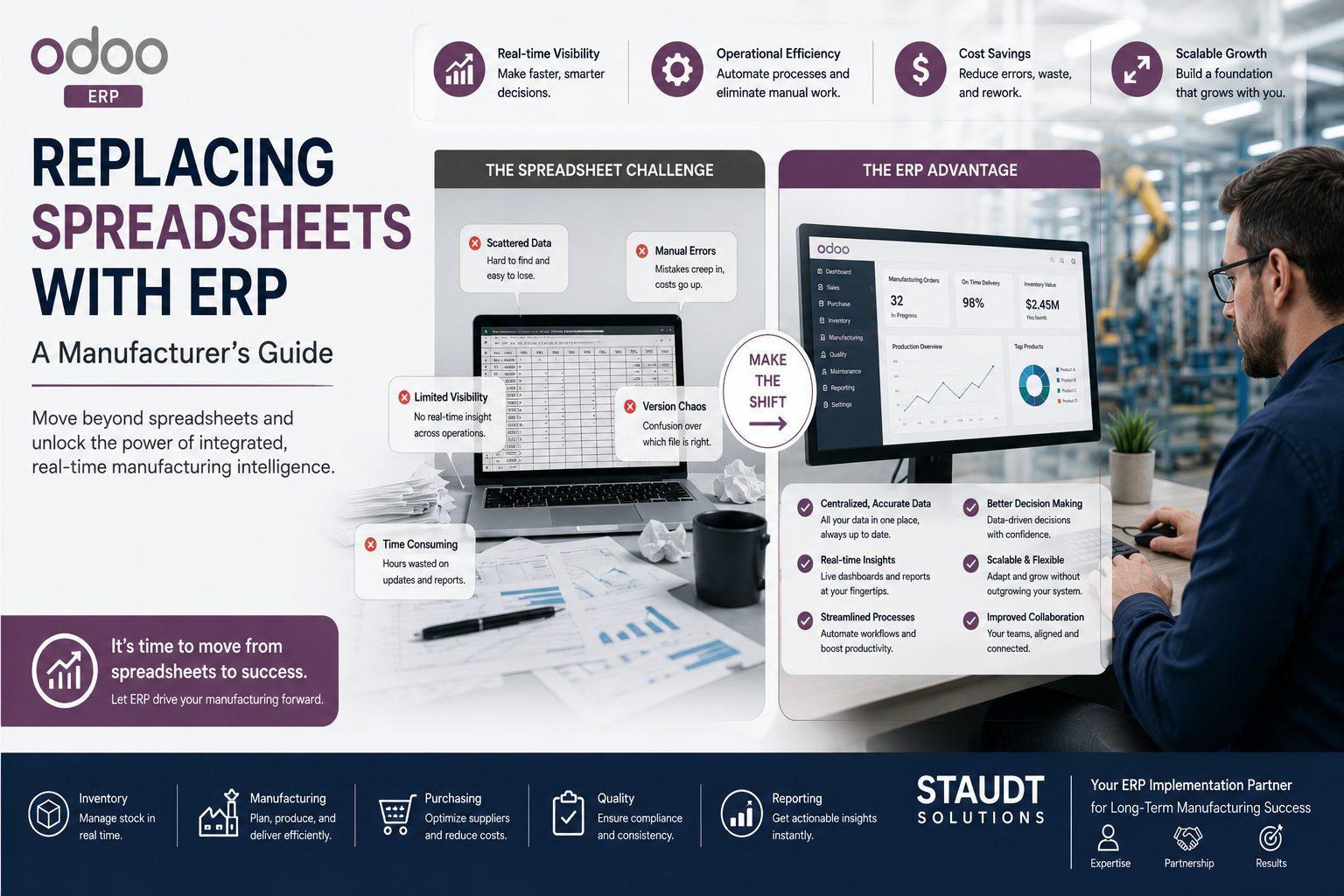
It usually happens gradually. One spreadsheet tracks inventory. Another tracks open orders. A third handles production scheduling. Each one made sense in isolation, built by whoever needed it at the time. Nobody sat down and designed this as a system — it accumulated. By the time a manufacturer notices the problem, there are often a dozen or more interconnected spreadsheets, each maintained differently, none of them talking to each other.
The Real Costs, Beyond the Obvious
Data lives in silos, and nobody has the full picture. Sales doesn’t know real-time inventory. Production doesn’t know what’s been promised to customers. Finance is reconciling numbers manually because nothing updates automatically. Decisions get made on stale or incomplete information without anyone realizing it.
Errors compound silently. A wrong formula, a manually mistyped quantity, a version of the spreadsheet that didn’t get updated — these mistakes don’t announce themselves. They surface weeks later as a stockout, a missed shipment, or a customer complaint, and by then it’s hard to trace back to the source.
Institutional knowledge becomes a single point of failure. If the one person who understands how the master scheduling spreadsheet actually works is out sick, on vacation, or leaves the company, that knowledge often leaves with them.
Scaling multiplies the problem, not the value. A spreadsheet system that mostly worked at $5M in revenue usually breaks down well before $15M, because the manual coordination effort grows faster than the business does.
What Actually Changes When You Move to ERP
Single source of truth. Inventory, production, sales, and finance data live in one connected system instead of a dozen disconnected files. When inventory changes on the floor, it updates everywhere else automatically.
Real-time visibility instead of end-of-week reconciliation. Decisions get made on current data, not last Tuesday’s spreadsheet snapshot.
Process consistency that doesn’t depend on any one person. Workflows are built into the system rather than existing only in someone’s head or their personal spreadsheet formatting habits.
Audit trail and accountability. Changes are tracked automatically — who did what, and when — instead of disappearing into an untracked cell edit.
What This Transition Is Not
Moving off spreadsheets doesn’t mean losing flexibility. It means the flexibility exists inside a structured system instead of an ungoverned patchwork. It also doesn’t mean every process gets fully automated on day one — a well-run implementation phases in complexity, starting with the highest-risk manual processes first.
Bottom Line
The signal that it’s time to move off spreadsheets isn’t a specific revenue number — it’s whether your current system is still giving your team an accurate, real-time picture of the business, or whether people have quietly stopped trusting it and started keeping their own shadow versions. If that’s already happening, the cost of waiting is higher than the cost of making the move.
Author Profile

- Principal Advisor | Business Systems Architect | Manufacturing & Operations | Helping Owners Replace Spreadsheets with Scalable Systems.