Manufacturing Operations: Guide for Growth (2026)

TL;DR: Manufacturing operations management coordinates production, quality, materials, equipment, and workforce to transform raw materials into finished products. Growing manufacturers ($5M-$50M revenue) face predictable scaling challenges: 67% rely on spreadsheets for critical operations, 58% lack dedicated operations leadership, and 72% struggle with system integration. The solution isn't always expensive software – process standardization delivers 18-25% efficiency gains before technology investments, and fractional operations leadership ($60K-$96K annually) provides expertise without full-time executive overhead ($195K-$260K).
What Are Manufacturing Operations?
Most manufacturers think operations means production. Learn more about gaining control of operations during growth. That's the problem.
Manufacturing operations is the integrated management of production processes, material flows, workforce coordination, equipment maintenance, and quality systems working together to transform inputs into finished products. According to SafetyCulture, "Manufacturing operations management is the process of managing, optimizing, and coordinating all aspects of manufacturing processes, from raw material procurement to delivery of finished products." The distinction matters because optimizing production alone while ignoring material management or quality control creates bottlenecks elsewhere in the system.
Companies between $5M and $50M revenue hit a predictable wall. Deloitte's engineering and construction outlook shows that mid-market manufacturers report systematic challenges: 67% rely on spreadsheets for critical operations, 58% lack dedicated operations leadership, and 72% struggle with system integration as they scale. These aren't technology problems – they're operations discipline problems that technology alone won't fix.
Manufacturing operations encompasses four core components that must work together. Production planning and scheduling determines what gets made and when. Material and inventory management ensures the right components arrive at the right time without excess carrying costs. Quality control and assurance prevents defects from reaching customers. Equipment maintenance and workforce allocation keep production running efficiently. When these components operate in isolation, manufacturers experience the classic symptoms: late deliveries, excess inventory, quality escapes, and unplanned downtime.
The financial impact is measurable. According to Deloitte's 2026 engineering and Construction Industry Outlook, real value added in manufacturing climbed to $890 billion in the second quarter – a 1% increase year over year. But manufacturers carrying $2M in inventory at 25% annual carrying cost spend $500K yearly on storage, insurance, obsolescence, and capital costs. Production delays that drop on-time delivery from 95% to 85% correlate with 20-30% lower customer retention rates. These aren't abstract metrics – they're cash leaving the business every month.
Key Takeaway: Manufacturing operations integrates production, materials, quality, equipment, and workforce management into a coordinated system. Mid-market manufacturers struggle most with system integration (72%) and lack of dedicated leadership (58%), not individual component performance.
What Are the Core Components of Manufacturing Operations?
Manufacturing operations breaks down into five interconnected components. Each one affects the others, which is why optimizing in isolation creates new problems downstream.
Material and Inventory Management
Material management controls what comes in, where it goes, and how much you keep on hand. The math is straightforward but the execution isn't. According to Fishbowl Inventory, effective material management tracks inventory levels, manages supplier relationships, and implements systems like FIFO (First In, First Out) to prevent obsolescence.
FathomHQ's financial KPI guide notes inventory carrying costs typically range from 20-30% of inventory value annually. For a manufacturer with $2M in raw materials and work-in-process, that's $400K-$600K in annual carrying costs covering warehousing, insurance, taxes, depreciation, and opportunity costs. Reducing inventory by 25% through better material planning saves $100K-$150K yearly without touching production efficiency.
The challenge for growing manufacturers is balancing availability against carrying costs. Too little inventory creates stockouts and production delays. Too much ties up cash and increases obsolescence risk. Material requirements planning (MRP) systems calculate optimal order quantities and timing based on production schedules, but they only work when bill-of-materials data is accurate and lead times are realistic.
Advanced Tech emphasizes that FIFO inventory management is critical for improving Overall Equipment Effectiveness, throughput and schedule adherence. Manufacturers who don't coordinate material flows with production scheduling sacrifice overall system performance.
Production Planning and Scheduling
Production scheduling determines what runs when, on which equipment, with which operators. Poor scheduling creates three problems: equipment sits idle waiting for materials, rush orders disrupt planned production, and changeover time between products wastes capacity.
L2L emphasizes implementing Just-in-Time (JIT) production to "produce what is needed, when it is needed, and in the amount needed to minimize inventory costs and reduce waste." JIT works when production schedules align with actual demand and suppliers deliver reliably. It fails when schedules change constantly or supplier lead times vary unpredictably.
Advanced production scheduling reduces lead times by 15-30% and improves on-time delivery by 20-35% by optimizing equipment utilization and minimizing changeover waste. Lab Manager's ROI calculation guide explains the ROI comes from increased throughput on existing equipment rather than capital investment in new capacity. A manufacturer running at 60% OEE (Overall Equipment Effectiveness) has 40% capacity sitting unused – better scheduling captures that capacity before buying new machines.
On-time delivery rates above 95% correlate with 20-30% higher customer retention and 15-25% revenue growth in manufacturing. The metric measures percentage of orders delivered by customer-requested date.
Quality Control and Assurance
Quality management prevents defects rather than catching them after production. The cost difference is significant: scrapping a defective part costs materials and labor, but shipping a defect to a customer costs materials, labor, warranty claims, and customer relationships.
According to Glassdome, one manufacturer reduced quality issues dramatically by installing automated product monitoring: "By installing the Glassdome Product Monitoring solution and automating the method with real-time data collection, the quality issues were dramatically reduced." Real-time monitoring catches process drift before it produces rejects.
ROI Institute's value case studies show quality systems track first pass yield (FPY) – the percentage of products passing inspection the first time. A manufacturer with 85% FPY scraps or reworks 15% of production. Improving FPY to 95% cuts scrap and rework by two-thirds. The implementation requires statistical process control, operator training, and equipment calibration, but the payback typically occurs within 6-12 months through reduced material waste alone.
For regulated industries like pharmaceuticals or medical devices, quality systems must meet stringent requirements. CalHR's government training ROI guide discusses FDA 21 CFR Part 11 compliance requires electronic signature controls, comprehensive audit trails, and validation documentation for all manufacturing operations. ISO 9001 certification processes require 6-12 months of documentation, training, and audit preparation for manufacturers with 50-200 employees.
Equipment and Maintenance Operations
Equipment downtime kills throughput. Unplanned downtime is worse than planned maintenance because it happens at random times, often during critical production runs. Manufacturing Success notes that "by proactively monitoring equipment during regular operations, manufacturers can reduce the risk of unexpected downtime."
Harvard Business School's project ROI guide notes unplanned downtime costs manufacturers $260K per hour on average – and that's just direct costs, not lost customer confidence. Preventive maintenance programs reduce unplanned downtime by 30-50% and extend equipment life by 20-30% compared to reactive "fix it when it breaks" approaches. The direct benefits include improved safety, prolonged asset life, and streamlined production. The indirect benefit is predictable capacity – production schedules work when equipment runs reliably.
Overall Equipment Effectiveness (OEE) measures how effectively plants use their equipment. According to Fishbowl Inventory, world-class manufacturing operations achieve OEE of 85% or higher, average manufacturers operate at 60%, and OEE below 40% indicates significant operational inefficiencies requiring immediate attention.
The challenge is balancing maintenance frequency against production time. Too much preventive maintenance wastes capacity on unnecessary inspections. Too little allows failures that stop production. Condition-based maintenance using sensors and predictive analytics optimizes the balance by performing maintenance based on actual equipment condition rather than fixed schedules.
Workforce and Resource Allocation
Labor represents 15-25% of manufacturing costs in most operations. Workforce management optimizes that investment by matching skills to tasks, balancing workloads, and minimizing overtime. Poor workforce allocation shows up as bottlenecks where skilled operators are scarce and idle time where operators wait for work.
Cross-training programs reduce bottlenecks by creating flexibility. When operators can run multiple machines or perform multiple tasks, production schedules adapt to demand variations without hiring additional staff. The implementation requires training time and documentation, but the payback comes from reduced overtime and improved throughput.
Research from BCG found that manufacturing leaders who implemented structured workforce management decreased their time spent in meetings by 30%, freeing up 140 leadership hours each month – nearly the capacity of an additional full-time leader. This demonstrates how systematic workforce coordination creates operational leverage beyond direct labor savings.
Workforce scheduling software reduces labor costs by 10-15% and improves productivity by 12-18% through better resource allocation. The ROI comes from matching staffing levels to actual production requirements rather than maintaining excess capacity for peak demand periods.
Key Takeaway: The five core components – materials, production scheduling, quality, equipment maintenance, and workforce – must integrate rather than optimize independently. A manufacturer with $2M inventory saves $100K-$150K annually by reducing inventory 25% through better material planning, while quality improvements from 85% to 95% FPY cut scrap costs by two-thirds.
How Do You Optimize Manufacturing Operations?
Optimize manufacturing operations through four steps: assess current state to identify constraints, standardize processes to reduce variability, integrate systems to eliminate manual data reconciliation, and establish performance monitoring to sustain improvements. For more details, see manufacturing ERP implementation.
Most manufacturers start optimization in the wrong place. They buy software before documenting processes, or they implement lean tools without understanding their constraints. The result is expensive technology that automates broken processes.
Conduct Operations Assessment
Operations assessments identify where the system is actually constrained. According to Tulip's manufacturing trends analysis, comprehensive operations assessments in mid-market manufacturing typically surface 15-25 distinct opportunities, with 3-5 high-impact quick wins achievable in the first quarter.
The assessment methodology examines five areas: material flow from receiving through shipping, production scheduling and changeover practices, quality control sampling and inspection procedures, equipment maintenance practices and downtime patterns, and workforce utilization and skill distribution. Data collection takes 3-6 weeks depending on facility complexity.
A comprehensive assessment examines process documentation (are standard operating procedures current and followed?), data quality (can you trust system data for decision-making?), system integration (do systems share data automatically or require manual reconciliation?), performance metrics (what KPIs are tracked, how often, and who acts on them?), and organizational capabilities (do you have the skills and structure to sustain improvements?).
The output is a prioritized list of improvements with estimated ROI and implementation timelines. Quick wins – improvements deliverable within 90 days – build momentum and fund longer-term initiatives. A manufacturer might reduce changeover time by 50% through better tooling organization (quick win) while planning an MES implementation (12-month project).
For a $20M manufacturer, a typical assessment might reveal: $180K in excess inventory due to poor demand forecasting (90-day payback), $240K in expedited freight costs from schedule instability (immediate savings), 12% scrap rate vs. 6% industry benchmark ($320K annual opportunity), and 15 hours weekly spent manually reconciling production data ($45K annual labor cost).
Implement Process Standardization
Process standardization eliminates variability that creates defects and inefficiencies. Epicflow's manufacturing trends report shows manufacturers implementing process standardization across operations achieve 18-25% efficiency improvements by eliminating process variability and accelerating employee onboarding.
Standardization starts with documenting current-state processes, identifying best practices, and creating standard work instructions. The documentation must be visual and accessible at the point of use – laminated work instructions at workstations, not binders in offices. Operator input during documentation improves accuracy and increases adoption.
reports that one manufacturer reduced changeover times by 50% and increased productivity by 27% using the kaizen methodology. Kaizen events are proven to decrease changeover times and increase output and responsiveness to customer demand.
The implementation challenge is change management. Experienced operators resist standardization when they perceive it as questioning their expertise. The solution is framing standardization as capturing their knowledge rather than constraining their judgment. When operators help create standards, they become advocates rather than resistors.
L2L emphasizes focusing on continuous improvement (Kaizen): foster a culture where every employee is encouraged to suggest ways to improve processes. This behavioral shift connects frontline workers with operational improvements.
Integrate Manufacturing Systems
System integration eliminates manual data reconciliation between ERP, MES, QMS, and other manufacturing systems. According to Fishbowl Inventory, mid-market manufacturers implementing best-of-breed systems without integration strategy report 35% higher total cost of ownership and 40% more time spent on manual data reconciliation compared to integrated platform approaches.
Integration architecture matters more than individual system selection for mid-market manufacturers. Disconnected systems create data silos where production data lives in MES, financial data lives in ERP, and quality data lives in QMS with no automated connection. The result is manual data entry, reconciliation errors, and delayed decision-making.
Integration options include native integrations (systems from the same vendor), pre-built connectors (middleware connecting specific systems), and custom APIs (programmatic connections). For mid-market manufacturers with limited IT resources, selecting systems with native integration capabilities or pre-built connectors reduces integration costs by 40-60% and cuts implementation timelines by 3-6 months.
Integration priorities include ERP to shop floor (connect business planning systems with production execution), quality systems (integrate inspection data with production tracking and corrective actions), maintenance systems (link equipment condition monitoring with work order management), and inventory systems (synchronize material consumption, receipts, and stock levels).
Establish Performance Monitoring
Performance monitoring sustains improvements by making results visible and actionable. Springer's manufacturing study shows effective manufacturing operations focus on 3-5 primary KPIs selected based on current constraints (capacity, quality, cost, or delivery) rather than comprehensive dashboards with 15-20 metrics that dilute management attention and slow decision-making.
The KPI selection framework starts with identifying the current constraint. A capacity-constrained manufacturer tracks OEE and changeover time. A quality-constrained manufacturer tracks first pass yield and scrap rate. A delivery-constrained manufacturer tracks schedule adherence and on-time delivery. The metrics must connect to the constraint or they don't drive improvement.
Dashboard implementation requires real-time data collection from production equipment and manual processes. Modern MES systems automate data collection through machine integration and operator terminals. The dashboard displays current performance against targets with trend analysis showing whether performance is improving or degrading.
found that transformation success hinges on leadership alignment with frontline teams, centered on six behavioral shifts that connect ambition with execution. Leaders must embody the operating system's guiding principles and rigorously apply them in day-to-day actions. The longevity of any transformation ultimately depends on the collective behavior of people in the organization.
Key Takeaway: Operations optimization follows assess-standardize-integrate-monitor sequence rather than starting with technology purchases. Process standardization delivers 18-25% efficiency gains before system investments, while proper integration architecture reduces total cost of ownership by 35% compared to disconnected best-of-breed approaches.
What Systems Support Manufacturing Operations?
Manufacturing operations systems fall into four categories: ERP for business planning, MES for shop-floor execution, QMS for quality management, and inventory/supply chain software for material management. Learn more about ERP implementation timeline and budget planning. The boundaries between these systems matter because integration architecture determines total cost of ownership.
Enterprise Resource Planning (ERP)
ERP systems handle financial transactions, order management, and supply chain planning at the enterprise level. According to Oracle, "ERP systems manage business processes including financials, purchasing, sales, and supply chain planning at the enterprise level, while MES systems control and monitor production processes on the plant floor – the two must integrate for effective operations management."
Manufacturing ERP implementations for mid-market companies range from $30K-$150K for software and initial deployment, with annual maintenance and support fees of $15K-$60K (20-40% of license cost). The wide range reflects company size, number of users, customization requirements, and implementation approach. A 50-person manufacturer implementing a cloud ERP with minimal customization might spend $40K-$60K, while a 200-person manufacturer with complex routing and multi-site requirements might spend $100K-$150K.
ERP selection criteria for mid-market manufacturers should prioritize manufacturing-specific functionality over general business features. Required capabilities include multi-level bill-of-materials, routing and work center management, material requirements planning (MRP), capacity planning, and shop floor data collection integration. Generic business ERPs lack the manufacturing depth needed for complex production environments.
Implementation timelines range from 6-18 months depending on company size. A 50-person operation typically requires 6-9 months for phased rollout, while 200-500 employee manufacturers need 9-12 months. The timeline includes requirements definition, system configuration, data migration, testing, training, and go-live support. Companies attempting faster implementations sacrifice data quality or process optimization.
Manufacturing Execution Systems (MES)
MES provides real-time visibility and control of shop floor operations, tracking work-in-process, labor, equipment status, and material consumption. According to MESA International, "MES provides real-time visibility and control of shop floor operations, tracking work-in-process, labor, equipment status, and material consumption – bridging the gap between ERP planning systems and production equipment."
MES focuses on execution while ERP focuses on planning. ERP creates production orders based on customer demand and material availability. MES executes those orders by dispatching work to equipment, tracking progress in real-time, collecting quality data, and reporting completion back to ERP. The integration between ERP and MES determines whether manufacturers have real-time visibility or rely on end-of-shift manual data entry.
ASEE's manufacturing education study notes MES implementations cost $50K-$200K for mid-market manufacturers depending on facility size and equipment integration complexity. A single production line with 5-10 machines might cost $50K-$80K, while a facility with multiple lines and 30-40 machines might cost $150K-$200K. The cost includes software licenses, equipment integration, configuration, and training.
The ROI comes from reduced work-in-process inventory, improved schedule adherence, and faster problem identification. Manufacturers implementing MES typically see 15-25% OEE improvements with investment payback within 12-24 months through reduced downtime and improved throughput.
Quality Management Systems (QMS)
QMS software implementations for manufacturers with 50-200 employees typically range from $25K-$100K, with ISO 9001 certification processes requiring 6-12 months of documentation, training, and audit preparation. According to MasterControl, QMS implementations in this size range follow a phased approach: document control and training (months 1-3), process implementation and internal audits (months 4-8), and certification audit preparation (months 9-12).
QMS integrates with MES and ERP to automate quality data collection and nonconformance tracking. When quality inspections occur on the shop floor, MES captures the data and routes nonconformances to QMS for corrective action. When material quality issues occur, QMS links to ERP for supplier corrective action requests. The integration eliminates manual data entry and ensures quality issues trigger appropriate responses.
The implementation challenge is balancing documentation requirements against operational efficiency. Over-documentation creates bureaucracy that slows production. Under-documentation fails audits and allows quality escapes. The solution is risk-based documentation that focuses on critical processes while simplifying low-risk areas.
Inventory and Supply Chain Software
Inventory management systems track material locations, quantities, and movements from receiving through shipping. For manufacturers, inventory systems must handle raw materials, work-in-process, and finished goods with lot traceability and FIFO/LIFO valuation methods.
Many mid-market manufacturers start with inventory modules within their ERP rather than standalone systems. The advantage is native integration – inventory transactions automatically update financial records and trigger material requirements planning. The disadvantage is limited warehouse management functionality compared to dedicated warehouse management systems (WMS).
The decision point is warehouse complexity. Manufacturers with simple warehousing (single location, limited SKUs, no complex picking) succeed with ERP inventory modules. Manufacturers with complex warehousing (multiple locations, thousands of SKUs, wave picking, cross-docking) need dedicated WMS with barcode scanning and directed putaway/picking.
Advanced Tech emphasizes that manufacturing operations management software coordinates the operations of functions found in every manufacturing organization. The result is lower unit production costs through better material coordination.
Key Takeaway: Manufacturing systems architecture requires ERP for planning, MES for execution, QMS for quality, and inventory software for materials. Mid-market ERP implementations cost $30K-$150K with 6-9 month timelines for 50-person operations, while MES adds $50K-$200K with 15-25% OEE improvement potential.
How Do Growing Companies Scale Manufacturing Operations?
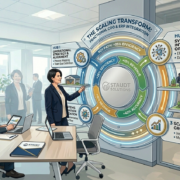
Scaling manufacturing operations follows predictable patterns based on revenue thresholds. Companies face different operational challenges at $5M-$15M, $15M-$30M, and $30M-$50M revenue ranges. The solutions that work at one stage create constraints at the next.
Scaling Stage 1: $5M-$15M Revenue
Manufacturers in the $5M-$15M range outgrow spreadsheet-based operations but don't yet justify enterprise software investments. According to DevoxSoftware's manufacturing roadmap, manufacturers in this revenue range achieve best ROI by prioritizing process documentation (6-9 months), implementing basic ERP (6-12 months), and establishing quality systems – deferring advanced analytics and automation until processes stabilize.
The operational priorities at this stage are process standardization, basic system implementation, and quality foundation. Process documentation captures tribal knowledge before key employees leave. Basic ERP replaces spreadsheets for order management, inventory tracking, and financial reporting. Quality systems establish inspection procedures and corrective action processes.
The leadership challenge is founder transition. Learn more about fractional COO responsibilities. Learn more about fractional COO vs full-time executive comparison. Companies in this range typically have founder-operators who understand production intimately but lack time for strategic operations improvement. The solution isn't immediately hiring a full-time COO – it's bringing in fractional operations expertise to assess current state, prioritize improvements, and guide system selection.
Scaling Stage 2: $15M-$30M Revenue
The $15M-$30M stage is characterized by system integration needs. According to Aprio's manufacturing playbook, this revenue stage requires connecting ERP with shop floor systems (MES), integrating quality management, implementing MOM coordination software, and hiring dedicated operations expertise (Plant Manager, Operations Director, or fractional COO).
Production complexity increases at this stage. Multiple product lines, custom configurations, and growing customer demands strain basic ERP systems. The symptom is manual workarounds – production schedules in spreadsheets despite having ERP, quality data in separate databases, and equipment maintenance tracked on paper.
The system integration priority is connecting planning (ERP) with execution (MES). When production orders flow automatically from ERP to shop floor terminals, and completion data flows back in real-time, manufacturers gain visibility that enables better decision-making. The integration eliminates manual data entry and reduces the lag between production events and management awareness.
The leadership addition at this stage depends on internal capability. Companies with strong plant managers might add a fractional COO for strategic guidance while plant managers handle daily execution. Companies without strong operations leadership need either a full-time operations director or more intensive fractional support (3-4 days monthly vs. 2 days monthly).
When to Add Operations Leadership
OxMaint's CMMS implementation guide discusses full-time manufacturing COO compensation averages $150K-$200K base salary plus 30% benefits and payroll taxes ($195K-$260K total). According to Salary.com, this reflects mid-market manufacturing compensation in 2025. Fractional COO services range from $5K-$8K monthly ($60K-$96K annually) for 2-3 days per month.
The decision framework considers three factors: operational complexity, internal capability, and growth trajectory. High operational complexity (multiple facilities, complex products, regulated industry) justifies full-time leadership earlier. Strong internal capability (experienced plant managers, capable supervisors) allows fractional support to work longer. Rapid growth trajectory (30%+ annually) requires full-time leadership to build scalable infrastructure.
Fractional COO engagements typically involve 2-3 days per month providing strategic operations guidance, conducting assessments, coaching existing managers, and driving improvement initiatives. According to Chief Outsiders, this model delivers experienced leadership without full-time commitment or overhead.
The timing trigger for adding operations leadership – fractional or full-time – is when operational issues consume executive attention that should focus on strategy and growth. If the CEO spends 50%+ of time solving production problems, quality issues, or delivery delays, operations leadership becomes the highest-ROI investment.
Fractional COO & Business Systems Advisory | Staudt Solutions helps growing manufacturers assess operations, select systems, and implement improvements without full-time executive overhead. The focus is practical operations improvement that delivers measurable ROI, not theoretical frameworks that look good in presentations but fail in production environments.
Key Takeaway: Manufacturers scale through three stages: $5M-$15M focuses on process documentation and basic ERP, $15M-$30M requires system integration and dedicated operations leadership, $30M-$50M demands optimization and scalable infrastructure. Fractional COO services ($60K-$96K annually) provide expertise without full-time overhead ($195K-$260K) for companies needing strategic guidance rather than daily operational management.
What Metrics Measure Manufacturing Operations Performance?
Five critical metrics measure manufacturing operations: Overall Equipment Effectiveness (OEE) for capacity utilization, on-time delivery for customer satisfaction, first pass yield for quality, cost per unit for profitability, and inventory turns for working capital efficiency. For more details, see business systems for operational efficiency.
Most manufacturers track too many metrics or the wrong metrics. Dashboards with 20+ KPIs dilute focus and slow decision-making. The solution is selecting 3-5 metrics aligned to current constraints.
Production Efficiency Metrics
Overall Equipment Effectiveness (OEE) is calculated as Availability × Performance × Quality. According to Vorne Industries, world-class manufacturing operations achieve OEE of 85% or higher, average manufacturers operate at 60%, and OEE below 40% indicates significant operational inefficiencies requiring immediate attention.
The OEE calculation breaks down as follows: Availability measures uptime (planned production time minus downtime divided by planned production time). Performance measures speed (actual production rate divided by ideal production rate). Quality measures yield (good parts divided by total parts produced). A manufacturer with 85% availability, 90% performance, and 95% quality achieves 72.7% OEE (0.85 × 0.90 × 0.95).
The value of OEE is identifying which factor constrains performance. Low availability points to equipment reliability issues. Low performance indicates speed losses from minor stops or reduced operating speeds. Low quality reveals process control problems. The diagnostic capability makes OEE more valuable than simple throughput metrics.
Changeover time measures how long equipment sits idle during product transitions. According to Manufacturing Success, one manufacturer reduced changeover times by 50% and increased productivity by 27% using the kaizen methodology. The ROI from changeover reduction is immediate – every minute saved in changeover is a minute available for production.
Quality and Delivery Metrics
On-time delivery rates above 95% correlate with 20-30% higher customer retention and 15-25% revenue growth in manufacturing. The metric measures percentage of orders delivered by customer-requested date. The challenge is defining "on-time" – some customers accept delivery within a week of request date, others require same-day precision.
First pass yield (FPY) measures the percentage of products passing inspection the first time without rework or scrap. According to Fishbowl Inventory, FPY directly impacts profitability because rework consumes labor and materials without generating additional revenue. A manufacturer improving FPY from 85% to 95% cuts scrap and rework costs by two-thirds.
Customer return rate tracks defects that escape final inspection and reach customers. This metric matters more than internal quality metrics because customer returns damage relationships and generate warranty costs. A manufacturer with 2% customer returns might have 95% FPY internally – the 5% caught by final inspection never ships, but the 2% that escapes creates customer problems.
Financial Operations Metrics
Cost per unit should be tracked by product line with 5-10% annual improvement targets as operations mature. The calculation includes direct materials (typically 40-60% of cost), direct labor (15-25%), and overhead (20-35%). The breakdown reveals where improvement efforts should focus – a product with 60% material cost needs supplier negotiation or design changes, while a product with 30% labor cost needs process automation.
Inventory turns measure how many times inventory cycles through the facility annually. The calculation is cost of goods sold divided by average inventory value. A manufacturer with $10M annual COGS and $2M average inventory achieves 5 turns annually. Increasing turns to 6 reduces average inventory to $1.67M, freeing $330K in working capital.
The challenge with inventory turns is balancing efficiency against service level. Higher turns reduce carrying costs but increase stockout risk if demand spikes or suppliers delay. The optimal turn rate depends on demand variability and supplier reliability – stable demand with reliable suppliers supports higher turns than volatile demand with unreliable suppliers.
Key Takeaway: Effective operations metrics focus on 3-5 KPIs aligned to current constraints rather than comprehensive dashboards. OEE calculation (Availability × Performance × Quality) identifies whether capacity constraints stem from downtime, speed losses, or quality issues, while on-time delivery above 95% correlates with 20-30% higher customer retention.
Frequently Asked Questions
How much does manufacturing operations software cost? For more details, see improving operations without hiring full-time executives.
Manufacturing operations software costs $30K-$150K for mid-market ERP implementations, $50K-$200K for MES systems, and $25K-$100K for QMS, with annual maintenance fees of 20-40% of license costs.
The total cost depends on company size, number of users, and integration complexity. A 50-person manufacturer implementing cloud ERP with basic MES integration might spend $80K-$120K total, while a 200-person manufacturer with multiple production lines and complex quality requirements might spend $200K-$350K. Implementation timelines range from 6-18 months depending on scope and internal resources.
What is the difference between manufacturing operations and production management?
Manufacturing operations encompasses production management plus material management, quality control, equipment maintenance, and workforce coordination as an integrated system.
Production management focuses on what gets made, when, and on which equipment. Manufacturing operations management coordinates production with material flows, quality systems, maintenance schedules, and workforce allocation. The distinction matters because optimizing production scheduling alone while ignoring material availability or equipment reliability creates bottlenecks elsewhere in the system.
How long does it take to implement a manufacturing ERP system?
Manufacturing ERP implementations require 6-9 months for 50-person operations and 9-12 months for 200-500 employee manufacturers using phased rollout approaches.
The timeline includes requirements definition (4-8 weeks), system configuration and customization (8-16 weeks), data migration and testing (6-10 weeks), training (4-6 weeks), and go-live support (2-4 weeks). Companies attempting faster implementations sacrifice data quality or process optimization. The critical path is usually data migration – cleaning up years of spreadsheet data takes longer than software configuration.
When should a growing manufacturer hire operations leadership?
Add operations leadership when operational issues consume 50%+ of executive attention that should focus on strategy and growth, typically occurring between $15M-$30M revenue.
The decision depends on operational complexity, internal capability, and growth trajectory. Companies with multiple facilities, complex products, or regulated industries need leadership earlier. Strong internal capability (experienced plant managers, capable supervisors) allows fractional support to work longer. Rapid growth (30%+ annually) requires full-time leadership to build scalable infrastructure.
What is Overall Equipment Effectiveness (OEE) in manufacturing?
OEE = Availability × Performance × Quality, measuring how effectively manufacturing equipment converts planned production time into quality output.
World-class operations achieve 85%+ OEE, average manufacturers operate at 60%, and OEE below 40% indicates significant inefficiencies. The calculation breaks down as: Availability (uptime percentage), Performance (actual speed vs. ideal speed), and Quality (good parts vs. total parts). A manufacturer with 85% availability, 90% performance, and 95% quality achieves 72.7% OEE. The diagnostic value is identifying which factor constrains performance – low availability points to reliability issues, low performance indicates speed losses, and low quality reveals process control problems.
Can manufacturing operations be improved without replacing existing systems?
Yes – manufacturers achieve 30-50% of potential improvements by optimizing processes within existing systems, implementing integration middleware, and adding targeted modules before full system replacement.
Process standardization delivers 18-25% efficiency gains before technology investments. Integration middleware (iPaaS) connects existing systems to eliminate manual data reconciliation. Targeted modules (WMS, MES, advanced planning) address specific gaps without full ERP replacement. This approach defers costly replacements by 2-5 years while capturing immediate ROI from process improvements and better system utilization.
What are the biggest manufacturing operations challenges for mid-market companies?
Mid-market manufacturers struggle most with lack of real-time production visibility (68%), manual data reconciliation between systems (58%), inadequate production planning tools (52%), and difficulty scaling processes as volume grows (47%).
According to Boston Consulting Group surveys, these challenges stem from outgrowing spreadsheet-based operations without yet justifying enterprise software investments. The solution isn't always expensive technology – process standardization and basic system integration address visibility and data reconciliation issues before advanced software becomes necessary.
How does a fractional COO help with manufacturing operations?
Fractional COOs provide strategic operations guidance, system selection expertise, process improvement leadership, and manager coaching for 2-3 days monthly without full-time executive overhead.
Fractional engagements focus on assessment and prioritization, system selection and implementation guidance, process improvement initiatives, and leadership development. The model works best for manufacturers between $10M-$40M revenue who need expertise for system selection, scaling preparation, or operational maturity improvement but don't yet justify $195K-$260K full-time COO overhead.
Taking Control of Manufacturing Operations
Manufacturing operations optimization isn't about buying the most expensive software or implementing every lean tool. It's about understanding your constraints, standardizing processes to reduce variability, integrating systems to eliminate manual reconciliation, and establishing metrics that drive improvement.
The scaling path is predictable. Companies between $5M-$15M need process documentation and basic ERP. Companies between $15M-$30M require system integration and dedicated operations leadership. Companies between $30M-$50M focus on optimization and scalable infrastructure. The mistakes happen when companies skip stages or implement solutions designed for the next stage before mastering the current one.
The ROI is measurable. Process standardization delivers 18-25% efficiency gains. Inventory reduction of 25% saves $100K-$150K annually on $2M inventory. Quality improvements from 85% to 95% FPY cut scrap costs by two-thirds. OEE improvements of 15-25% increase throughput on existing equipment without capital investment.
For manufacturers ready to scale operations systematically, the starting point is assessment. Understand current constraints, identify quick wins, and prioritize improvements based on ROI and implementation complexity. Whether you pursue improvements with internal resources, fractional expertise, or full-time leadership depends on operational complexity and growth trajectory – but the assessment comes first.
Ready to Get Started?
For personalized guidance, visit Fractional COO & Business Systems Advisory | Staudt Solutions to learn how we can help.
Author Profile

- Principal Advisor | Business Systems Architect | Manufacturing & Operations | Helping Owners Replace Spreadsheets with Scalable Systems.